
If your traffic just dropped during a Google core update, don't rewrite your site in the first 48 hours. Here's what to do after a Google core update. Start by confirming the update on the Google Search Status Dashboard. Wait until the rollout is marked complete, then wait at least one more full week. Then compare that week in Google Search Console with a week before the rollout began. A small move, such as position 2 to position 4, usually isn't a reason to overhaul it. A large, sustained drop is a reason to check whether your pages still help people more than what now outranks them.
Google released the November 2026 core update on November 10, 2026, at 10:07 a.m. Pacific, which is 1:07 p.m. Eastern. Google says it applies globally, to all languages, and may take up to two weeks to complete. As of November 20, 2026, the dashboard still lists the rollout with no completion time, so the picture isn't final.
This month is easy to misread, because holiday demand and a major Search AI upgrade landed in the same window. Diagnose first, then decide whether to wait, improve, or ask for a free website review.
Key takeaways
Confirm before you react. Check the Search Status Dashboard for the official start and end dates.
Compare the right weeks. Use a full week after completion against a week before November 10, 2026.
Small drops need patience. Google advises against changing content that already performs well.
Large, sustained drops need a quality review. Judge the site as a whole, then the hardest-hit pages.
Rule out look-alikes. Holiday demand, AI Overviews, and tracking glitches can mimic a core update.
Ignore guaranteed fixes. Google promises no recovery timeline.
What is a Google core update, and what is it not?
A Google core update is a broad change to Google's ranking systems. Google says these updates help it deliver helpful and reliable results, and they happen several times a year. According to Google Search Central, core updates "don't target specific sites or individual web pages."
So a core update isn't a manual action or a penalty. Pages that move down are not necessarily "bad." Better candidates may simply have moved ahead.
A core update also differs from a spam update. Google's dashboard lists four separate spam updates in 2026 (March, June, August, and September). The November event is labeled a core update. Google has not said which ranking systems changed.
2026 Search ranking event | Start date on the dashboard | Official duration as of Nov 20, 2026 |
|---|---|---|
March 2026 core update | 27 Mar 2026 | 12 days, 4 hours |
May 2026 core update | 21 May 2026 | 11 days, 21 hours |
September 2026 spam update | 24 Sep 2026 | 13 days, 16 hours |
November 2026 core update | 10 Nov 2026 | No completion time listed yet |
Source: official ranking history on the Search Status Dashboard, checked November 20, 2026.
Before you decide the update hit you, confirm what actually moved.
How do you confirm a traffic drop is really a core update?
In November 2026, at least four causes can produce similar charts. Sorting them out first saves weeks of wasted edits.
Check the Google Search Status Dashboard
Open the ranking history on the dashboard and write down the start date. Once Google posts a completion time, record that too. Earlier November rollouts ran past two weeks, at 23 days in 2024 and nearly 26 days in 2023.
Look at the shape of the change
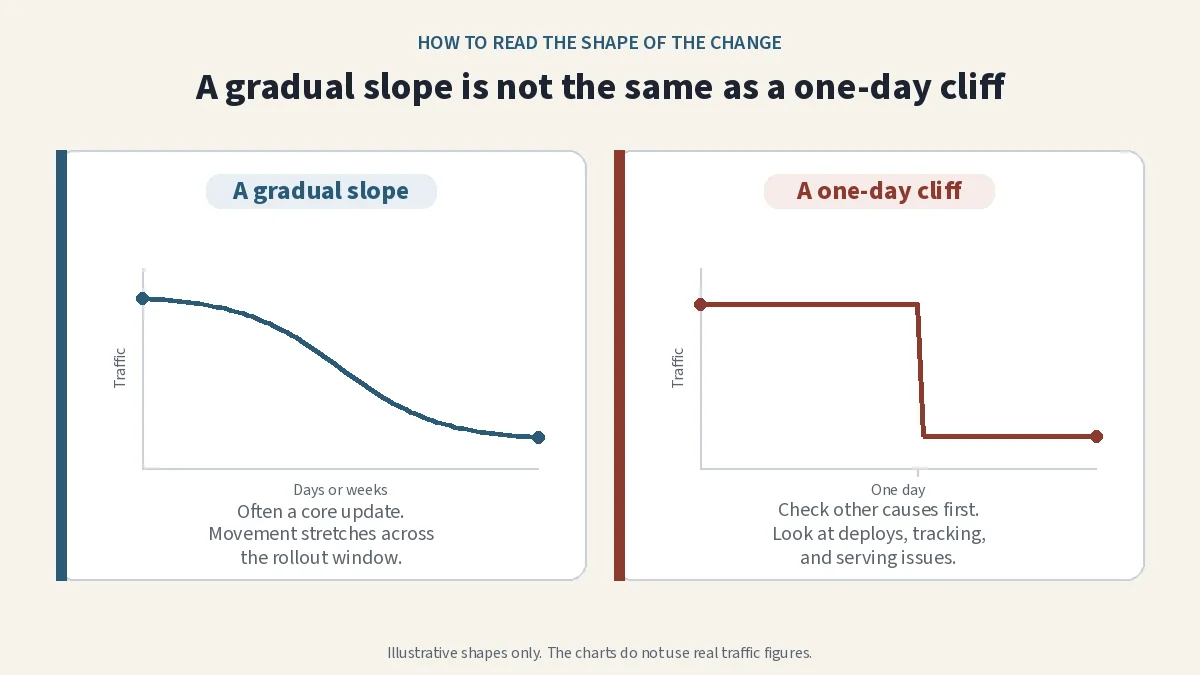
Core updates roll out over days or weeks. In Search Console, that often looks like a slope, not a single-day cliff. A sharp one-day drop is usually a reason to check other causes first. Recent deploys, tracking changes, and serving issues top that list.
Separate four causes that look alike this month
If you see this | A more likely cause | What to check first |
|---|---|---|
Rankings and clicks move together across the rollout window | Core update | Dashboard dates, then the Search Console comparison below |
Clicks shift while rankings hold during Thanksgiving week | Seasonal demand | Same week last year, plus non-holiday pages and queries |
Positions hold, but clicks or AI impressions fall | AI Overviews or AI Mode change | Whether the query now shows an AI feature |
A one-day cliff, or a drop limited to a new or moved section | Technical or tracking issue | Recent deploys, analytics tags, robots rules, and canonicals |
The AI row needs extra care this month. On November 12, 2026, Google rolled Gemini 4 Hydrogen into Search for all users, Search Engine Land reported. Google called it the "biggest model upgrade to Search yet," with effects in AI Mode and AI Overviews. Semrush also reported that Google confirmed a logging error lowered generative AI impressions from November 9 to 11.
If clicks fell while rankings held, our guide to how SEO and AI search optimization differ explains that split. For a closer look at the two answer surfaces, see ChatGPT Search vs. Google AI Overviews. If you want help checking how those surfaces describe your business, see our AI SEO services. Local businesses should also check whether the change came from the map pack, since Google Maps and organic search rank differently.
Recently redesigned or moved domains? Run the website migration SEO checklist first. For a managed move, see our website migration SEO service.
Once the core update looks like the likely cause, use Google's date comparison, not yesterday's sessions.
How should you read Search Console after a core update?
Daily traffic swings mislead almost everyone. Google publishes a simple four-step process that works for a single shop or a franchise.
Confirm the rollout is finished. Use the dashboard, not social media chatter.
Compare the right dates. Wait at least a full week after completion. Then compare that week with a week before November 10, 2026.
Review top pages and queries. Decide whether each drop is small or large.
Analyze search types separately. Check Web Search, Google Images, video, and the News tab on their own.
Why the first comparison week can mislead US businesses this time
If the rollout ends near November 24, the following week includes US Thanksgiving on November 26. Black Friday follows on November 27, and Cyber Monday lands on November 30. Demand that week won't match a normal mid-November week.
So compare year over year where you can, and watch rankings and queries, not only sessions.
How does Google define a small drop versus a large one?
Change in position | Google's example | What Google suggests |
|---|---|---|
Small drop | Position 2 to 4 | No drastic action, and avoid changing content that already performs well |
Large drop | Position 4 to 29 | A deeper assessment, especially if the drop is sustained and site-wide |
Source: Google Search's core updates and your website.
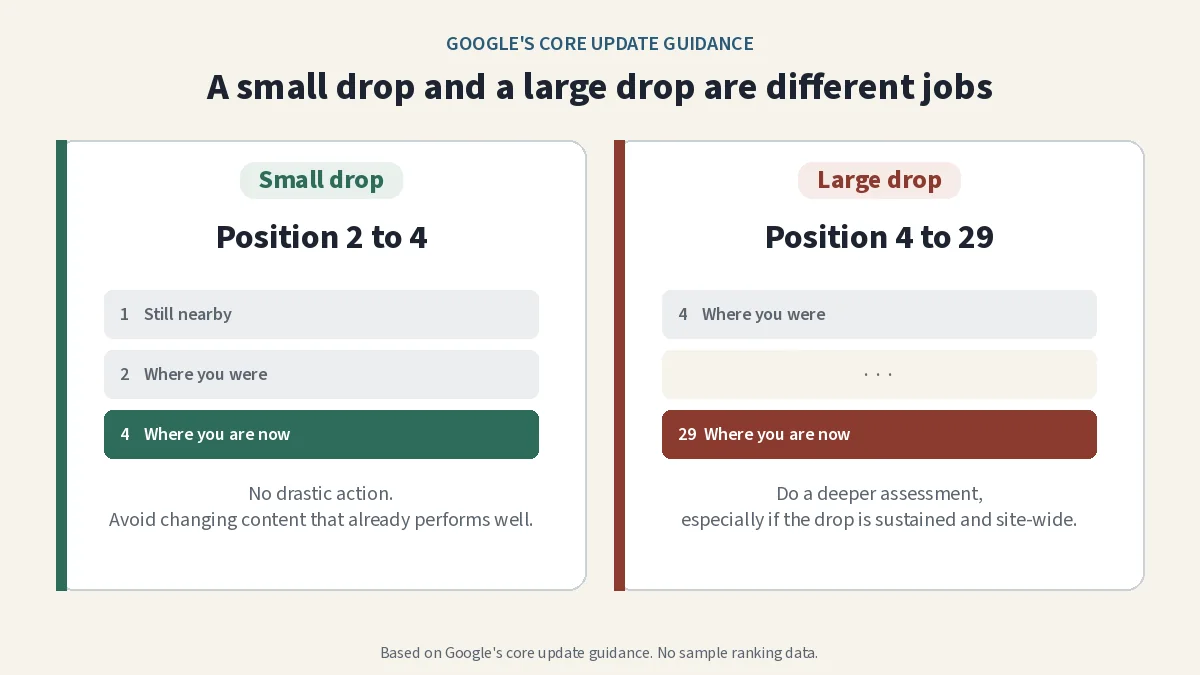
The size of the change decides your next step.
What if the drop is small or traffic went up?
It's tempting to "refresh everything" just to stay safe. Google specifically warns against quick fixes, such as removing a page element because someone called it bad for SEO.
Instead, write down your baseline numbers and keep doing the useful work you already planned. Revisit the data after the comparison week. A page that slipped from position 2 to 4 still earns visibility.
A large, sustained drop is a different job.
What if the drop is large and sustained?
A steep chart feels urgent, but no "recovery hack" fixes it. Treat it as a reason to take an honest look at quality.
Look at the site as a whole, then at the hardest-hit pages
Google asks owners to judge whether the whole site delivers helpful, reliable, people-first content. Its people-first self-assessment questions are the right checklist. Google also suggests asking trusted people outside your business to review the pages.
Then compare your weakest pages with what now ranks or gets cited. Does each page help the buyer finish the job better than the alternatives? A competitive analysis can make that comparison clearer.
Improve what you can back up
Lasting improvements include clearer structure, first-hand proof, current facts, a closer query match, and a next step you can keep. For local and service companies, stronger service pages often matter more than another generic blog.
Earned mentions and reviews also help show why people should trust you, which is the focus of off-page SEO. If you need structured data to make those facts easier to read, see schema markup for service businesses.
If you need help producing that work, see our SEO content writing team and editorial content strategy service. Page-level fixes such as titles, headings, and internal links fall under on-page SEO.
Sometimes the review turns up crawl, index, or template problems instead of thin content. In that case, start with technical SEO. If both kinds of issues appear, read technical SEO vs. content SEO to decide what comes first.
Treat deletion as a last resort
Google calls deleting content a last resort. Wanting to delete whole sections can signal those sections were built for search engines first. Mass deletion or noindexing belongs in a careful audit, not a weekend purge. Our guide to what an SEO audit should include shows how a proper review handles that.
Improvements take time, and nobody can honestly promise a date.
How long can recovery take?
Google is direct about timing. Some changes can show in a few days. Others can take several months for Google's systems to confirm that the site now produces helpful, reliable, people-first content.
In some cases, the bigger move arrives with the next core update. Google also runs smaller, unannounced core updates between the named ones. Google also says there is no guarantee that your changes will produce a noticeable impact.
For a broader view of timing, see our article on how long SEO takes. That piece covers starting an SEO program, while this one covers core update recovery.
If you can't tell what changed, or don't have time for an honest review, outside help is worth it. If you are choosing between hiring in-house and working with a firm, read in-house SEO vs. an agency.
When should you get help, and which promises should you ignore?
You can run the dashboard check and the Search Console comparison yourself. Outside help makes sense in a few situations:
The drop is large and sustained after the comparison week.
The cause is mixed across organic search, local results, and AI features.
The site is large, or it spans many locations.
Your team lacks time to review the affected pages honestly.
A free website review is the simplest starting point, with practical priorities based on your site. Deeper problems may call for SEO audit services, which need Search Console and analytics access. Bigger brands can look at an enterprise SEO audit or a franchise SEO audit. Larger sites with many templates can also start with enterprise SEO.
After the diagnosis, some teams want ongoing help through managed SEO services. Others only need a decision, and SEO consulting can help with that. Owners of a single location can start with SEO for small businesses.
Watch for SEO agency red flags after any core update. Be wary of guaranteed returns to old rankings and secret "core update fixes." The same goes for plans to rewrite your whole site mid-rollout. Want a calm second opinion first? Send your site for a free website review.
Frequently asked questions
What is a Google core update?
A Google core update is a broad change to Google's search ranking systems. Google makes these changes several times a year and announces them on the Google Search Status Dashboard.
Is a Google core update a penalty?
No. Google says core updates do not target specific sites or individual pages. A page that drops may simply face stronger alternatives. A manual action is a separate process, reported inside Search Console.
How long does a Google core update take to roll out?
Google said the November 2026 core update may take up to two weeks. The March and May 2026 core updates took about 12 days each. Earlier November rollouts ran longer, so check the dashboard for the official completion time.
How do I know if a traffic drop was caused by a core update?
Check whether the drop lines up with the official rollout dates. Then compare a full week after completion with a week before the start. A gradual slope fits a core update better than a one-day cliff, which often points to a technical or tracking issue.
What should I do after a Google core update?
Confirm the update on the dashboard and wait for completion plus one full week. Compare Search Console data with a pre-update week. Leave small drops alone. For large, sustained drops, review the site against Google's people-first questions and avoid quick fixes.
How long does it take to recover from a Google core update?
There's no set timeline. Google says some improvements show in a few days, while others take several months. Sometimes the change appears after the next core update. Google also says no change guarantees a noticeable impact.
Should I change my website while a core update is rolling out?
Avoid major changes until the rollout finishes. Google recommends waiting for completion, plus at least one full week, before analyzing results. Mid-rollout edits blur what caused any later movement.
Can a click drop be AI Overviews rather than the core update?
Yes. If your positions hold but clicks fall, AI Overviews or AI Mode may be answering the query. Google upgraded Search with Gemini 4 Hydrogen on November 12, 2026. Google has not said how the core update affects AI features.
Get a clear read before you change anything
This is a time for patience and evidence, not panic. Start with a calm look at your data, then make a plan your team can use.
Send us your website and describe the change you're seeing. A strategist reviews every request and replies with practical priorities and a defined scope. There is no sales script and no recovery guarantee.
Request your free website review or call (718) 252-5040.